

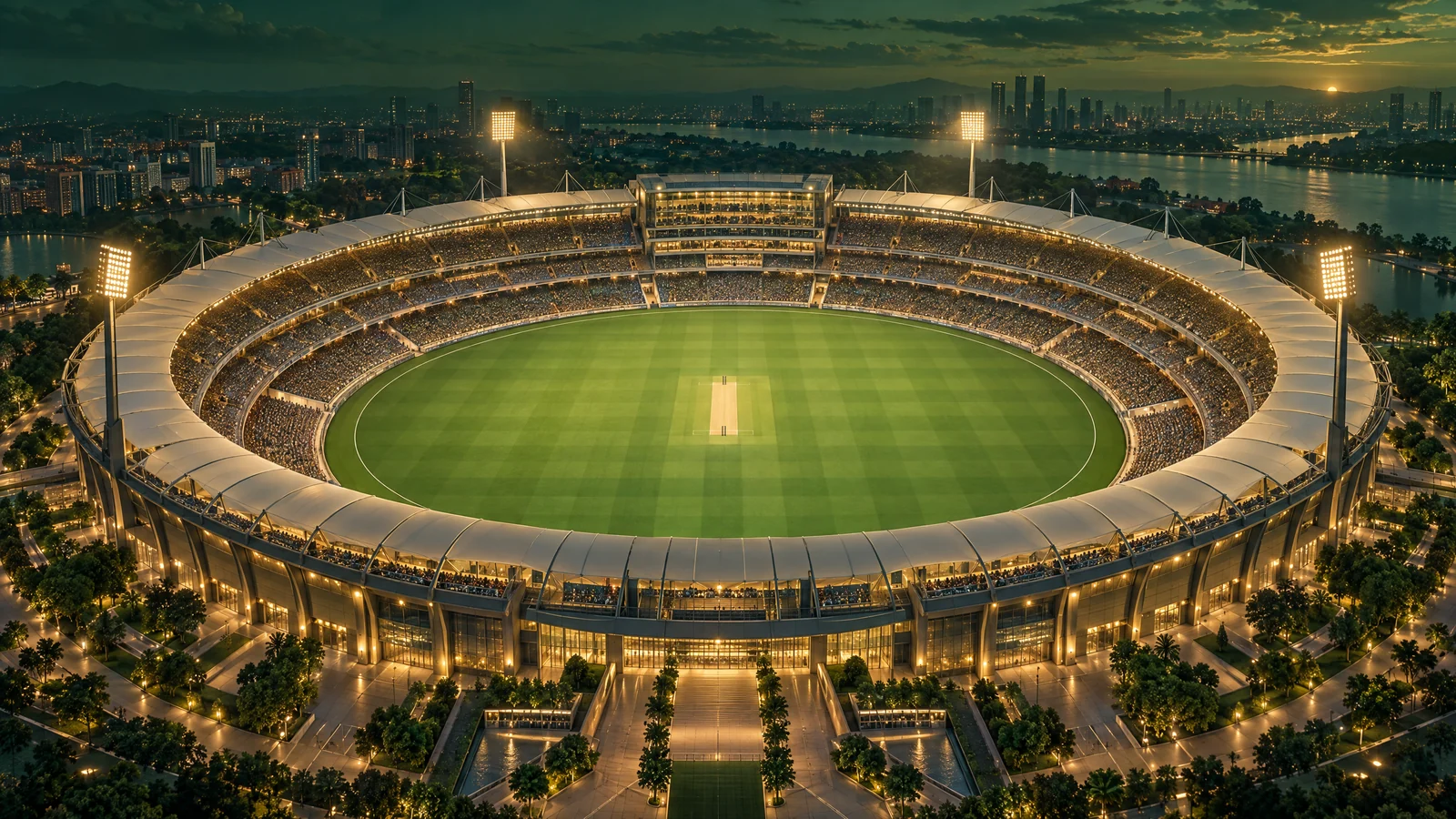
Original editorial illustration; not a photograph of a named player, match or stadium.
Figures checked: 10 November 2026

The Narendra Modi Stadium in Ahmedabad is the biggest cricket stadium in the world on the current published spectator-capacity basis used here, with a reported capacity of 132,000. The Melbourne Cricket Ground follows with 95,000 seats, while Eden Gardens, Shaheed Veer Narayan Singh International Cricket Stadium and Optus Stadium complete the first five positions in this snapshot.
This is a capacity-focused guide to completed, operating cricket venues. It uses current published seating or spectator figures supplied by venue operators, cricket boards and the listed ground sources. Capacity is not the same as playing area, boundary length, attendance at a particular match or a guarantee of how many people can enter a specific event configuration. For wider cricket reading, the sports guide index offers related articles without changing the capacity basis used below.
Top 10 biggest cricket stadiums at a glance
The list follows the published capacity figures described below. Where sources differ, the relevant entry explains the difference.
- Narendra Modi Stadium — Ahmedabad, India: 132,000 reported spectators.
- Melbourne Cricket Ground — Melbourne, Australia: 95,000 seats; about 100,024 total capacity when standing spaces are included.
- Eden Gardens — Kolkata, India: 68,000 on the current BCCI venue directory.
- Shaheed Veer Narayan Singh International Cricket Stadium — Nava Raipur, India: 65,000 widely reported, provisional because another published figure is 50,000.
- Optus Stadium / Perth Stadium — Perth, Australia: 60,000 seats.
- Adelaide Oval — Adelaide, Australia: 53,500.
- Bharat Ratna Shri Atal Bihari Vajpayee Ekana Cricket Stadium — Lucknow, India: 50,100 on the BCCI directory.
- Greenfield International Stadium — Thiruvananthapuram, India: 50,000.
- Barsapara Cricket Stadium — Guwahati, India: 46,000 on the BCCI directory.
- Barabati Stadium — Cuttack, India: 45,000, sharing the published cutoff with DY Patil Stadium in Navi Mumbai.
What “biggest” means in this list
Cricket venues do not always publish capacity in the same way. One operator may state seats, another may describe total spectator capacity, and a ground profile may retain an older figure. The list therefore does not pretend that every number is an engineering survey made on the same day.
The working rule is narrower and more useful: rank completed operating cricket venues by a current published spectator or seating figure, use explicitly separated seating figures where they are available, and place a visible caveat beside a disputed or provisional number. The result is a defensible editorial snapshot rather than a permanent global standard.
That distinction is especially important for the Melbourne Cricket Ground. Its operator gives 95,000 seats and about 5,000 standing spaces, producing a total capacity of 100,024. It is therefore second by seats in this article even though its all-in total is higher than the seated figure. The same principle applies to venues such as Ekana, where BCCI and ICC publish slightly different figures.
1. Narendra Modi Stadium — Ahmedabad, India — 132,000
The Narendra Modi Stadium is first on this published-capacity basis at 132,000 spectators. The BCCI venue directory gives the headline figure, while the Gujarat Cricket Association describes the ground as accommodating more than 1.3 lakh spectators. In practical terms, that places Ahmedabad well ahead of the other venues in this list.
The ground has an older history than its current enormous stands suggest. Gujarat Cricket Association records the original venue’s construction in 1982, reconstruction from 2015 and redevelopment completion in February 2020; BCCI describes the renovated stadium in 2021. At the older ground, Sunil Gavaskar reached 10,000 Test runs and Kapil Dev took his 432nd Test wicket. The rebuilt venue links that heritage with a far larger spectator capacity.
2. Melbourne Cricket Ground — Melbourne, Australia — 95,000 seats
The Melbourne Cricket Ground, commonly called the MCG, is second by 95,000 seats. Its operator separately identifies about 5,000 standing spaces, giving a total capacity of 100,024. Those two numbers are not interchangeable: this ranking uses the published seated figure so that the comparison remains closer to like-for-like seating capacity.
The MCG was built in 1853 and has a central place in cricket history. Cricket Australia records the first Australia–England Test at the ground in 1877. It also remains a Melbourne Stars Big Bash League home, giving the venue both heritage and contemporary cricket use. Readers looking at the BBL cricket guide can treat that league context separately from this seating-capacity comparison.
3. Eden Gardens — Kolkata, India — 68,000
Eden Gardens is third with a current BCCI-published capacity of 68,000. Older reports sometimes use 66,000, but this article follows the current BCCI directory figure. A proposed or future redevelopment figure is not treated as completed capacity.

The ground’s cricket history extends back many decades. The Cricket Association of Bengal records its first Test from 5 to 8 January 1934, its first ODI between India and Pakistan on 18 February 1987 and its first T20I, India against England, on 29 October 2011. BCCI records also identify Eden Gardens as the venue for the 1987 World Cup final. These milestones explain its importance, while the 68,000 figure explains its position here; no uncompleted expansion is counted.
4. Shaheed Veer Narayan Singh International Cricket Stadium — Nava Raipur, India — 65,000 reported
Shaheed Veer Narayan Singh International Cricket Stadium in Nava Raipur is fourth on the widely reported 65,000 figure. The ranking is explicitly provisional. The NDTV ground-page body gives 65,000, but the same source’s metadata gives 50,000. Indian Express describes the venue as India’s third-largest cricket stadium by seating without supplying a competing numeric figure.
Because those published numbers do not settle a single installed-seat count, 65,000 is presented as a reported basis rather than an unquestionable measurement. NDTV describes the venue as built in 2008, with its first match in 2010, and Indian Express confirms IPL, ODI and international T20 use. A reader may therefore see 65,000 in one place and 50,000 in another; the ranking retains the reported figure while marking it provisional.
5. Optus Stadium / Perth Stadium — Perth, Australia — 60,000 seats
Optus Stadium, also known as Perth Stadium, ranks fifth with 60,000 seats. Its official operator expressly gives the seated capacity as 60,000. Event configurations sometimes quote 61,266, but that figure is not treated as identical to the operator’s published seating capacity here.
Construction began in December 2013 and the venue opened on 21 January 2018. The operator confirms international cricket and Big Bash League use, making this a modern multipurpose venue that regularly hosts cricket rather than the older WACA Ground.
Perth’s franchise-cricket role sits alongside its international programme. The cricket-format guides explain the different competition contexts, which should not be confused with the stadium’s seating figure.
6. Adelaide Oval — Adelaide, Australia — 53,500
Adelaide Oval is sixth with 53,500 published capacity. Cricket Australia uses that rounded figure, while other references may show 53,583. The article follows the board’s published number instead of presenting the alternative as a more exact installed count.
The venue regularly hosts Test cricket, ODIs and Big Bash League matches. Adelaide Oval’s education material identifies redevelopment as completed in 2014. The rounded official figure is more useful here than treating a difference of a few dozen places as a major change in global standing.
7. Bharat Ratna Shri Atal Bihari Vajpayee Ekana Cricket Stadium — Lucknow, India — 50,100
The Bharat Ratna Shri Atal Bihari Vajpayee Ekana Cricket Stadium in Lucknow is seventh on the 50,100 figure published by BCCI. The ICC publishes 50,000, so this article records both figures as different published references rather than treating the extra 100 seats as proof of a newly built section.
Official material places the venue’s construction or opening in 2017. Uttar Pradesh cricket and the Lucknow Super Giants use the stadium, while ICC material notes Afghanistan’s home use in 2019. The venue was also renovated for the 2023 World Cup.
Lucknow’s IPL connection gives readers another reason to recognise the ground. The IPL cricket reference covers the tournament context; the 50,100 figure here remains a venue-capacity statistic.
8. Greenfield International Stadium — Thiruvananthapuram, India — 50,000
Greenfield International Stadium in Thiruvananthapuram, also known as The Sports Hub, is eighth with 50,000. The capacity is supported by the BCCI directory and by a Kerala Cricket Association catering document for an international match in December 2025. Older ground-profile figures of 55,000 are not used for this current-board-figure ranking.
The stadium is a cricket and multi-sport venue rather than a football-only ground. Kerala Cricket Association material confirms international cricket, including women’s T20I use. Using 50,000 rather than the older 55,000 figure keeps this entry consistent with the selected current evidence.
9. Barsapara Cricket Stadium — Guwahati, India — 46,000
Barsapara Cricket Stadium in Guwahati is ninth on the 46,000 capacity in the current BCCI directory. The ground is also known as Dr Bhupen Hazarika Cricket Stadium and Assam Cricket Association Stadium. ESPNcricinfo’s ground profile lists 40,000, so 46,000 is clearly identified here as the BCCI-published figure rather than an undisputed engineering count.
The venue is a recurring international and Assam cricket ground. Its alternative names are useful when the same location appears under different titles in scorecards or venue listings. The article keeps the BCCI source basis visible rather than combining it with the older profile into an artificial average.
10. Barabati Stadium — Cuttack, India — 45,000
Barabati Stadium in Cuttack completes the ten main profiles with a BCCI-published capacity of 45,000. The venue has a substantial international history: BCCI records its first ODI in January 1982 and first Test in 1987, and it has also hosted regular ODI cricket and the 2013 Women’s World Cup.
The tenth position is an editorial cutoff, not proof that Barabati is uniquely the world’s tenth-largest installed cricket venue. DY Patil Stadium in Navi Mumbai is an equal-capacity peer at 45,000 on its current operator facilities page. At that shared cutoff, this ten-venue selection uses Barabati, the alphabetically first name, while acknowledging the tie. A legacy DY Patil figure of 55,000 also appears in older material, which is why the current operator figure is used for the comparison.
The tie means there is no unique tenth-place venue under these published figures. DY Patil is not smaller than Barabati on the selected operator and board figures.
Important venues outside this ten-profile cutoff
Some well-known cricket grounds are deliberately not forced into the ranking when the evidence does not match the chosen current-figure rule. The Rajiv Gandhi International Cricket Stadium in Hyderabad is listed at 39,200 in the current BCCI directory, while an ICC 2023 World Cup venue page gives a maximum of 55,000. It is excluded because the sources use different capacity concepts; that is not a declaration that its physical potential is settled by the lower number.
JSCA International Stadium Complex in Ranchi is also left outside the ranked ten. The accessible official association material confirms venue use but does not provide a capacity. Other retrieved figures include 35,000 in an NDTV page body, 50,000 in its metadata and 39,000 in a 2019 news report. Ranking it at 50,000 would require choosing disputed evidence without a clear current installed-seating basis.
These exclusions distinguish current published seating from an event maximum, metadata field, old profile or unsupported repeated number.
How to compare cricket stadium capacities fairly
When a stadium’s number matters, first ask whether it means seats, total spectators or a maximum event configuration. Next, check whether the number belongs to the current venue or to an older ground on the same site. Finally, note whether the source is a venue operator, a cricket board, an international body or a secondary ground profile.
Seating can be reconfigured, sources can be updated and match-specific restrictions can reduce available places. A larger published capacity does not automatically mean a larger playing area, better view or different result on the field.
For a player-focused comparison, see our companion article on the highest run scorers in T20I cricket. It ranks an international batting record rather than the size of a venue.
Frequently asked questions
Which is the biggest cricket stadium in the world?
The Narendra Modi Stadium in Ahmedabad is first on this article’s current published-capacity basis, with a reported 132,000 spectators.
Is the Melbourne Cricket Ground’s capacity 95,000 or 100,024?
Both figures describe different components of the operator’s published information. The MCG gives 95,000 seats and about 5,000 standing spaces, producing a total capacity of 100,024. This ranking uses 95,000 seats for the ordered list.
Why is Raipur’s stadium ranking called provisional?
The Shaheed Veer Narayan Singh International Cricket Stadium is widely reported at 65,000, but the retrieved NDTV material also gives 50,000 in metadata. Since the published figures conflict, the fourth-place position is marked provisional.
Why are Eden Gardens and Greenfield shown with different capacity caveats?
Eden Gardens uses the current BCCI figure of 68,000 while older reports show 66,000. Greenfield uses 50,000 from current BCCI and Kerala Cricket Association material, while older profiles show 55,000. In both cases, the article follows the selected current evidence rather than mixing old and new numbers.
Are Barabati and DY Patil tied on capacity?
DY Patil shares the 45,000 published cutoff used for Barabati Stadium. It is identified as an equal-capacity peer, not as a smaller venue. The article keeps exactly ten main profiles and selects Barabati alphabetically at the tie.
Does stadium capacity decide the best cricket venue?
No. Capacity only describes the published spectator or seating figure used for this ranking. It does not measure playing area, pitch quality, viewing experience, boundary length, attendance record or match outcome.
Continue reading on Reddy Anna Sports Club for the wider cricket section. This capacity list is a dated comparison of published figures; it does not confirm ticket availability or a match-specific seating configuration.
